
Florida State University alumna Alexis Beucler (BFA Painting & Printmaking, minor in Art History, 2017; BA English Literature, 2017) is an American painter, educator, and interdisciplinary artist whose work explores intimacy, landscape, and queer identity through vivid, emotionally charged color. She earned her MFA in Painting & Drawing from the University of Iowa, with secondary focuses in Printmaking and Book Arts.
Now based in Los Angeles, Beucler is a tenure-track 2D Illustration Instructor at Pasadena City College. Since graduating from FSU, she has built a dynamic career spanning studio practice, teaching, murals, and exhibitions across the United States. Her paintings draw from hiking, camping, and travel to create layered landscapes where tenderness, love, and queer joy unfold.
In this alumni conversation, Beucler reflects on her journey since FSU, the evolution of her artistic practice, and the lessons she would share with emerging artists today.
Looking back at your time at Florida State University, what experiences or mentors most shaped your development as an artist?
During my freshman year, I enrolled in my first painting course with Mark Messersmith and never looked back. His use of color, maximalizing space, and focus on the landscape helped me see how paintings can create space– just by pushing pigment around on a surface, new worlds form. I dedicated all of my time to studio coursework and applied for the BFA program. I was lucky enough to get accepted and spent the next three years developing my artistic practice. One-on-one studio visits with faculty were key to my growth and helped me make personal, emotional, and cultural connections across various media. Big thanks to Mark for taking the time to help me look inward and realize where the art was coming from.
I enrolled in soft sculpture classes with Linda Hall– we collaborated with biologists, visited a long leaf pine forest, were introduced to Florida’s carnivorous pitcher plants growing on the side of highways, and held an ecology parade at a park dressed as native animals. She even had us collaborate with the community and make a yarn bomb (decorate trees with soft materials) and exhibited work in Georgia! The collaborative nature of this class and focus on landscape and environmentalism allowed me to look at my local environment much more closely. Nearly 10 years later, I’m working on a series of paintings that take direct inspiration from natural environments in California (where I now live).
Early on I realized I wasn’t reading enough (nerdy, I know), so I double majored in English Literature and pursued an Art History minor. Thank you Laci Mattison for introducing me to Virgina Woolf and feminist critiques– I remember our class diving deep into the inner lives of lead female characters and questioning how world events and cultural trends have subtle impacts on our motivations and the way we see ourselves in the world. I was amazed how Carey Fee designed her Arts of Asia course. It was one of the largest classes I have taken, but the way she structured it felt intimate– she presented on Tuesdays and assigned contemporary readings that responded to her presentation topics. On Thursdays I remember having lively class debates that challenged the traditional art history cannon.
I knew these English Literature and Art History courses were important for me to take, but I still felt like I was standing in a few different worlds. As with most students, everything started to make sense in my Junior year– I enrolled in artist book classes with AB Gorham. AB’s unique expertise as both a writer and artist helped me see a literal connection between my love for literature and painting. I began writing poetry and experimenting with blending text and imagery into artist books. I also interned with her at the Small Craft Advisory Press (SCAP) at FSU’s Facility of Arts Research (FAR) where I helped edition professional artist books! This is a fantastic learning opportunity for those of you looking for professional book experience that will increase your skillset. By the time I took Carrie Ann Baade’s Narrative Painting Class, everything finally “clicked.” At my core, I knew I wanted to be a story teller and her class introduced me to different ways of telling a story through painting. Since this special time at FSU, I’ve embraced narrative painting practices where I combine personal moments of my life, stories I’ve read, make references to art history, and tie ecological environments together.
Your work often explores the relationship between landscape, identity, and imagination. How has your artistic vision evolved since graduating from FSU?
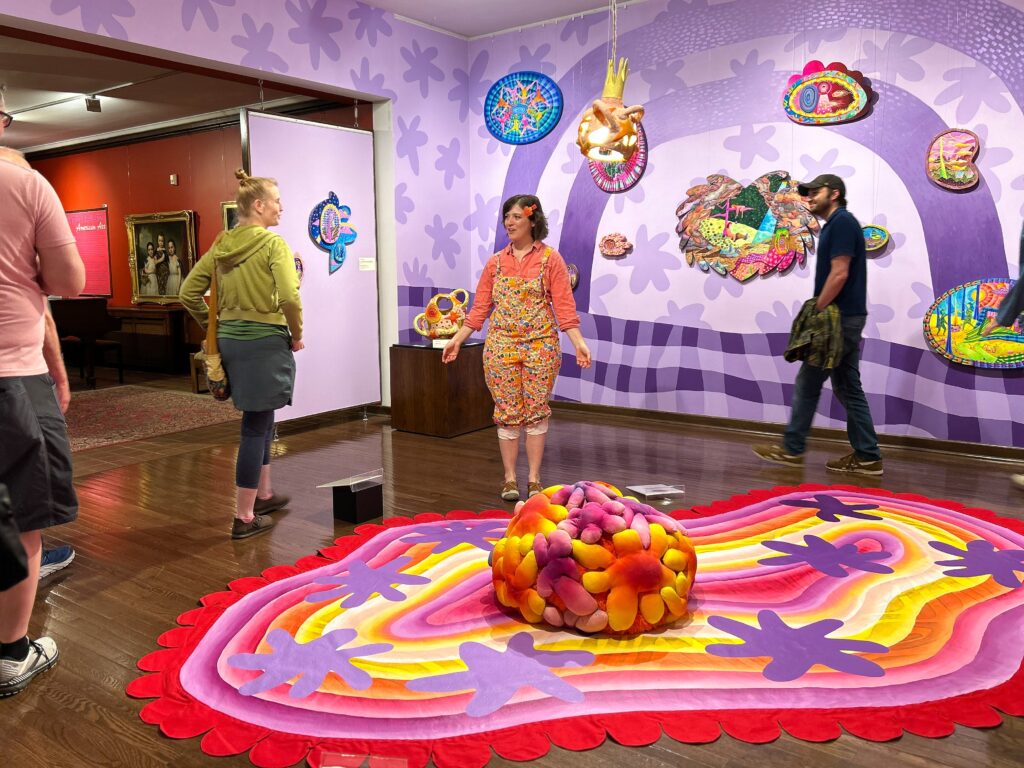
When I attended FSU, I made artwork that responded directly to the books I was reading, media I was consuming, historical paintings, and tried to make sense of the socio-political environment of our world at large. In short– it was overwhelming and I was overwhelmed– I threw everything onto the canvas and tried to make sense of it in a maximalist space– one of my BFA thesis projects was a 4 foot x 24 foot oil painting! The opportunity to exhibit in the FSU Museum of Fine Art was huge– I was able to share a large body of work with our community: a series of paintings that took 3 years to complete, large soft sculptures, and artist books! Leading up to this, I exhibited 14 times in student and community group exhibitions at FSU (Phyllis Straus Gallery), Railroad Square galleries, and several shows nearby in Georgia. Looking back, this exhibition experience was massive – it reinforced the importance of making art and gave me confidence to share it with others.
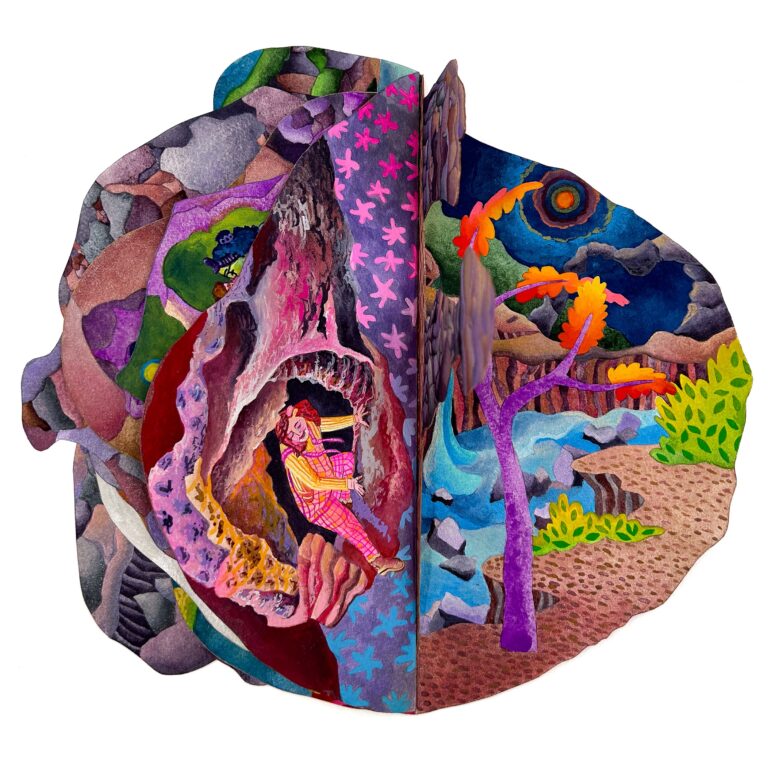
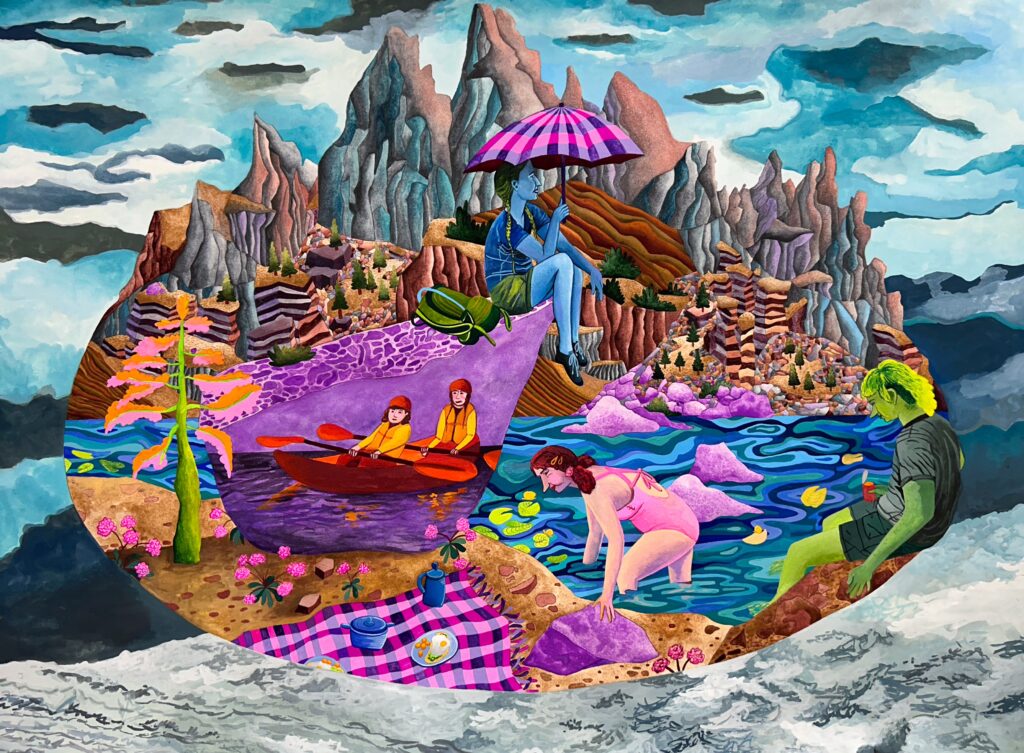
After FSU, I moved to Iowa. While I was expecting to be surrounded by Grant Wood’s rolling fields, the landscape was just as flat as Florida (minus the swamps). At this time, I started hiking and exploring nature more fervently. I opened up and embraced my queer identity– finding resilience and power in nature. I still take a loose approach to world building– moments in my work are grounded in observations from reality and other moments pull power from dreamlike, liminal spaces. I’m currently working on a series of paintings of figures camping within fractured-perspective landscapes. Distinct zones within each painting have unique color palettes that emphasize a lengthening of space and time.
You have built a career that includes studio practice, teaching, and curatorial work. How did you begin navigating these different roles after college?
Creating community and connecting people together is essential to a holistic art practice. Making work in the studio makes me a better professor; teaching art helps me see things more clearly to bring back into the studio; and curatorial work offers a collaborative space where my community and I can grow more organically together. Life is all about making connections and shifting our perspectives. I believe the mix of all three is the “magic sauce” to artist block and stagnation.
During my formative years at FSU, I found ways to integrate art making, teaching, and curatorial/collaboration together: I joined the Printmaking Club and taught printmaking and bookmaking demos to my peers; guest lectured for Liz Di Donna in the ART 1000 Success Strategies class; co-curated group exhibitions in the BFA Phyllis Straus Gallery; collaborated on soft sculpture projects and performance work; and worked tirelessly in the art studio.
After graduating from FSU, I knew I wanted to teach on the collegiate level and help inspire future generations. I strategically applied to 3-year graduate programs that offered teaching opportunities. At UIowa, I was able to teach 2 drawing classes each semester. After graduate school, I taught full time for 3 years at NIACC, a small rural community college in North Iowa. This was a whirlwind! I taught a ton of different classes, curated gallery exhibitions, and even had my first Museum Solo Show. Now, I’m teaching narrative painting practices (via illustration) full time in Los Angeles, CA.
I quickly found that one opportunity often leads to another– I had a body of work that was ready to exhibit and I remember making a proposal document. I reached out to lots of small, local galleries by stopping by their locations or via phone. I volunteered to jury shows and helped with art fundraising events. As I made more connections, I shared exhibition opportunities with friends and former students. Just this effort of putting myself out there helped me gain confidence and expertise. Remember, at the end of the day, you are your biggest cheerleader! It can be easy to be discouraged and lose motivation, but believe in yourself, continue making art that feels important to you, and apply for opportunities! The world can feel cut-throat, but it doesn’t have to be. Share your art, knowledge, and opportunities with your community and grow together.
What challenges did you face in the first few years after graduating, and what strategies helped you sustain your creative practice?
Transitions after college are often difficult because they are a sudden, radical shift from being a student to being an artist out in the world– there’s a loss of structure and routine, identity shift, social isolation, economic and career pressure, and decision paralysis. These feelings are completely natural and for me, they were compounded with the Covid-19 Pandemic. I graduated with my MFA in the spring of 2020. Talk about isolation! Looking back on periods of transition, I have a few strategies I like sharing with students no matter what year they are in college– because it’s never too late to develop professional art practices that sustain our art practice.
Strategy 1: Structured Studio Time. When we take art classes in school, it might feel like work that we don’t always want to do. It’s easy to take studio courses for granted– but realize, these are structured times where you get to be creative! If you’re taking 4 studio art classes– you’re most likely on campus for 12 hours and spending at least 8 hours of homework– that’s 20 whole hours each week where you get to make art (but let’s be real, it’s usually a lot more time than that). As you approach graduation, ask yourself– how can I continue making art for 10 or 20+ hours a week on top of a career? How can you structure your time and continue this routine? Summer and winter breaks are perfect practice. Structured studio time is such a gift.
Strategy 2: Find Your Community. In college, communities can be easy to find– classrooms, student clubs, social events, etc. Ask yourself– what community am I a part of? Who can I connect with? And how can I maintain this connection after college? Try to meet up with classmates and friends outside of formal school events– this will make meetups feel more natural after graduation. If you’re not sure what to do, invite friends to get together at a local art museum, wander around First Fridays at Railroad Square, etc, hike at a local park, or draw at coffee shops! Social anxiety is real, I get that, but social isolation after college is worse.
Strategy 3: Develop Professional Art Practices. It’s never too early to develop your professional art practice skills (even if you’re a freshman). Create an artist website, start taking professional quality photos of your artwork (ask professors for help), write an artist statement, artist biography, and start that CV art resume. As you grow as an artist, it’ll be easy to revise statements and updating your website with current images of work will be second nature. When you’re able to see all of your work in one place, you’ll be able to find global trends (formal or conceptual) in the work– ask yourself, how are my sculptures, paintings, and performance artworks related?
What advice would you give current FSU art students who are trying to build a life in the arts after graduation?
Consider this – your job is your side-hussle that supports you to make artwork– it’s not the other way around. Don’t do something that asks too much from you (takes up all of your time or emotional space). Find balance– eat healthy food, have a sleep routine, and exercise. Remember the end goal– we want to make art for as long as we can, so treat your body and mind well.