
From painting immersive environments for Disney and Epic Universe to contributing to productions at Yale and the Santa Fe Opera, FSU alumna Michaela Meyer (BFA Studio Art, BA Religion, 2023) has quickly built an impressive career in scenic art. Since graduating from Florida State University, Meyer has combined technical mastery, creative problem-solving, and a passion for large-scale visual storytelling to bring theatrical and experiential worlds to life. We recently caught up with Michaela to discuss her journey from FSU to some of the nation’s most prestigious production environments, the skills that prepared her for success, and her advice for current art students considering careers beyond the traditional studio.
FSU Painting & Drawing Area Head and Professor Carrie Ann Baade recently interviewed Michaela Meyer, FSU Art BFA alum (’23). Their conversation is documented below.
1. Looking back at your time at Florida State University, what experiences, courses, or faculty mentors most shaped your development as an artist?
There were so many impactful experiences I had during undergrad, but the most artistically significant one was my thesis project. The training leading up to it was extremely thorough. I found the beginning of my voice and the direction that I wanted to take my art as a result. Jeff Beekman, my major professor for my thesis, gave me a lot of confidence in my ideas and encouraged my ambitions. Carrie Ann Baade, the head of the program, helped me to go deeper in my thinking. I felt very equipped to pursue art by the time I graduated because of it.
2. Scenic painting is a fascinating extension of traditional studio practice. When did you first realize that theatrical design and scenic art might be part of your path?
For my thesis project, I was thinking about the sublime and decided to create an immersive landscape painting that was 14.5’ x 9’. It was my first time making something at such a large scale, and I learned that I love being physically immersed in a project like that. I also loved being challenged by something that was so daunting at the time. It unlocked strengths I didn’t know I had, and it was exciting to push myself to the edge of what I thought I was capable of. I found out that this skill could translate to scenic art well after Carrie Ann Baade suggested I apply to Yale’s scenic art apprenticeship.
3. Your work now involves helping create immersive theatrical worlds at Yale. How does scenic painting differ from the kind of painting you were making as a student?
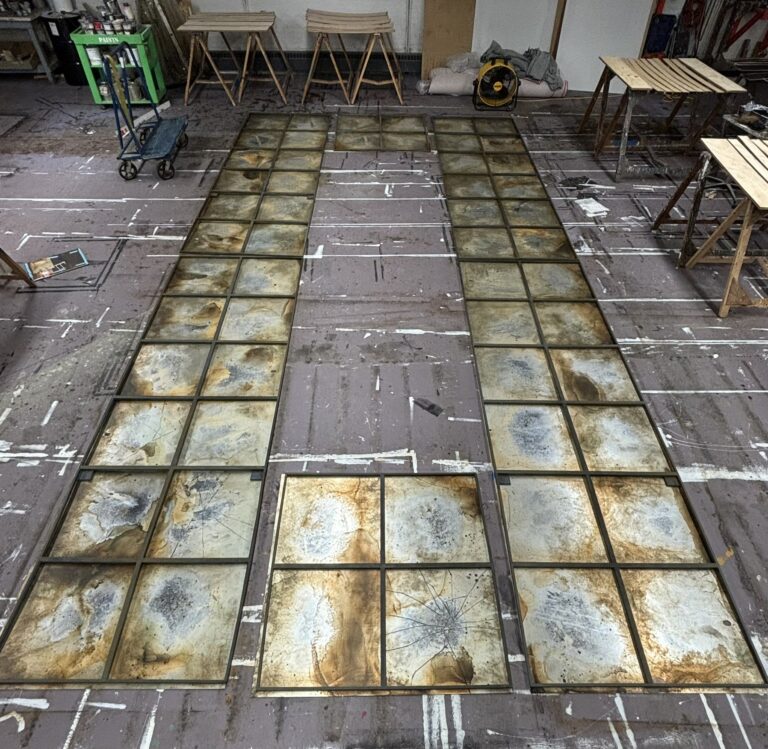
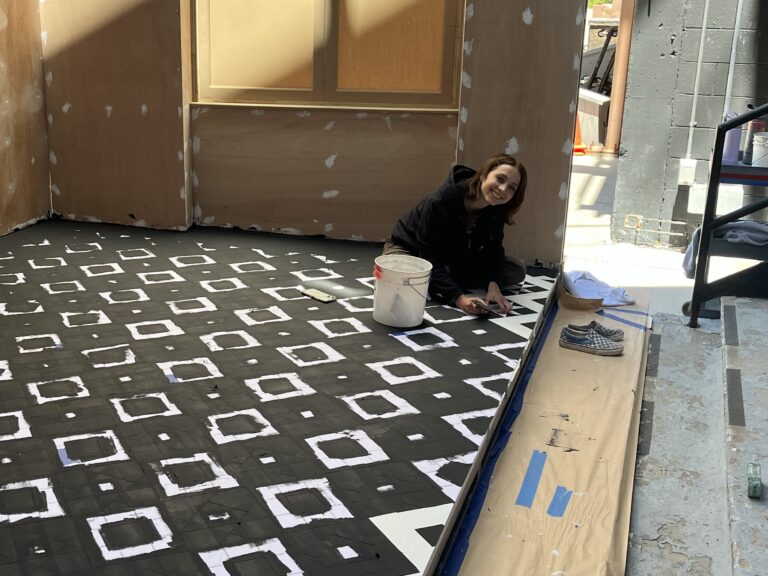
When I was a student, I was taught to develop my individual artistic voice. In theater, though, I am only one small part of a great effort, and everyone is working towards that same vision. Additionally, I have to become like a chameleon as a scenic artist. I’m constantly working with different designers who all have their own styles, and I have to stay true to their preferences without interfering. Many of the things I work on are also supposed to realistically mirror something else – like a brick wall, a tiled floor, et cetera. It is a common phrase in scenic art to ‘take your hand out of it,’ and if I did my job correctly, the audience should get immersed in the illusion of the set without being distracted by the fact that it was painted.
4. Scenic art requires collaboration, problem-solving, and translating design concepts into physical reality. What has surprised you most about working in that environment?
I was most surprised by how much I had to learn once I started working as a scenic artist. I spent practically my whole life developing my artistic skill, but once I entered this industry, it was like I had to learn a new language. Scenic art requires a different way of painting.
5. How has working at Yale expanded your understanding of painting, illusion, and visual storytelling?
Working at Yale was a departure from what I was doing before, which was painting for theme parks at Adirondack Studios in Orlando. Both were scenic art jobs, but there were a lot of key differences that I had to adjust to when I started painting for theater. For one, themed experiences are meant to last for decades, whereas the sets at Yale only lasted for the run of the show. That meant that I used different paints and didn’t have to think as much about the durability of the scenery. The way I painted also had to be different at Yale, because it would be seen from a much greater distance in the theater. This required me to use more contrast in order to translate the design effectively. I also worked as the paint charge for three shows during my time at Yale, which gave me a greater understanding of the planning that goes into a production. In this role, I budgeted for the design of the show, created samples to figure out how I wanted to achieve the look, and worked more closely with the designer.
6. Many students imagine painting careers primarily in terms of gallery practice. What would you say to artists who may not realize how many adjacent creative industries value their skills?
I would encourage them to broaden their options. There are endless ways to use your art across various industries. Many gallery artists still have to work a job alongside their studio practice, especially if they’re emerging. It’s exciting when that job can also be art! You don’t have to do just one thing. I still consistently make my own work when I get home, and it has been very fun to do both.
7. What were the biggest challenges in transitioning from undergraduate study into a highly demanding professional training environment?
For me, the biggest challenge in this industry is the need to be as efficient as possible while on the clock. Theater has a very quick turnaround, and I can’t afford to be precious with the scenery. At the same time, I want to do a good job, so I think walking that balance continues to be the thing I wrestle with the most. I could pull all-nighters in undergrad, but that sort of thing isn’t sustainable in this line of work, so I have to find a way to fit everything I need to do within the allotted time. Sometimes that means letting go of the ideal vision I had for it, but it also provides opportunities for me to be more creative with my process.
8. As someone early in an exciting creative career, what advice would you give current FSU art students about staying open to unexpected opportunities?
First and foremost, I would encourage current FSU art students to listen to the suggestions of other artists and supervisors. Many of the opportunities I have done since graduating were brought to my attention by artistic mentors. At the same time, though, take initiative and make researching opportunities a consistent practice. Get to know other artists, and learn from the paths they took. The art world is surprisingly small, and there’s already been a lot of overlap with people I’ve worked with throughout the years. Those connections are really important.
9. Do you have any advice for someone considering this field? I would recommend getting connected to a local theater and scenic artists in your area. Depending on where you are, there are scenic unions that you can join as well, like USA 829. For a formal scenic education, there are some great schools that have free tuition/paid certificate programs, like Yale and Juilliard. Also consider what field within the industry you’re interested in, because scenic art can span across many different forms – you could work for theaters, theme parks, museums, concerts, films, tv.. among countless others. Also, If you don’t like one aspect of scenic art, you can find something that fits better. For example, maybe you find out that you don’t enjoy painting scenery as much as building props. Try multiple avenues before settling on one.
For more information on Michaela’s work visit:
https://your.yale.edu/youryale/2026-02-23-setting-the-stage
https://art.fsu.edu/fsu-art-2023-alumni-interview-with-michaela-meyer/