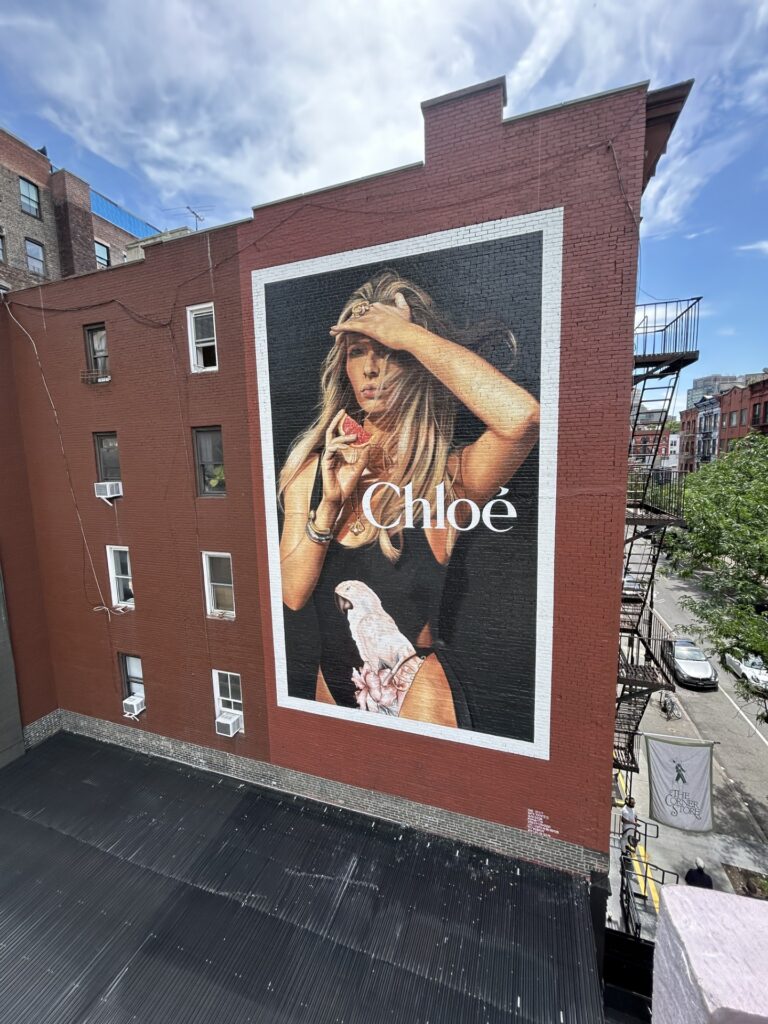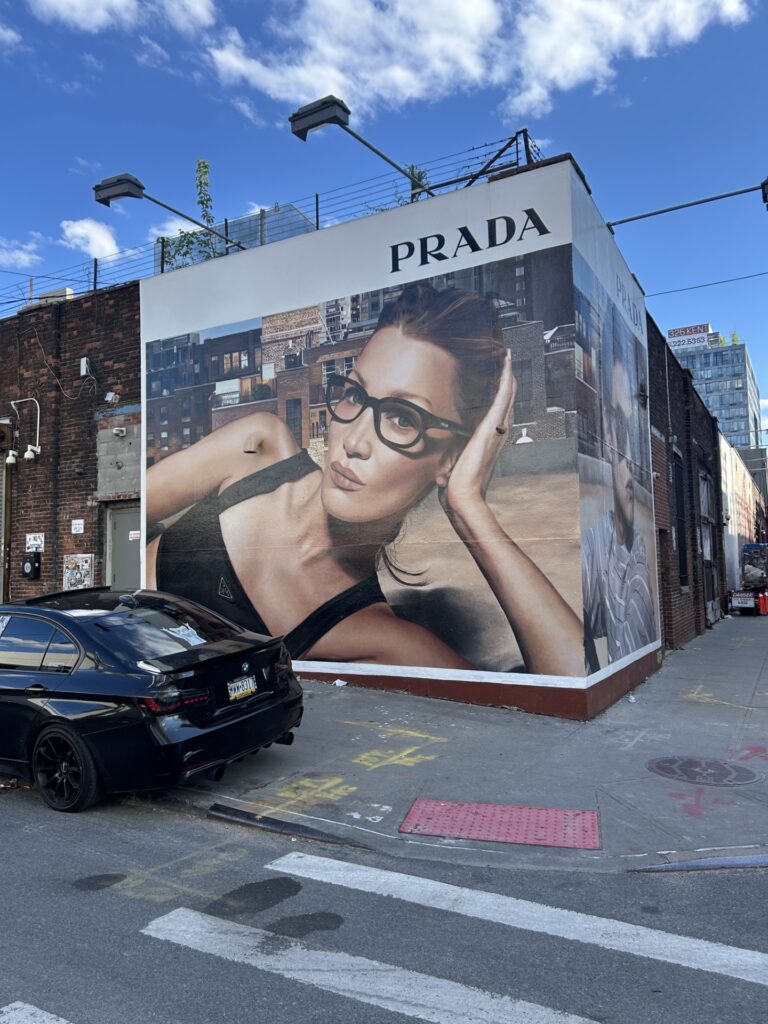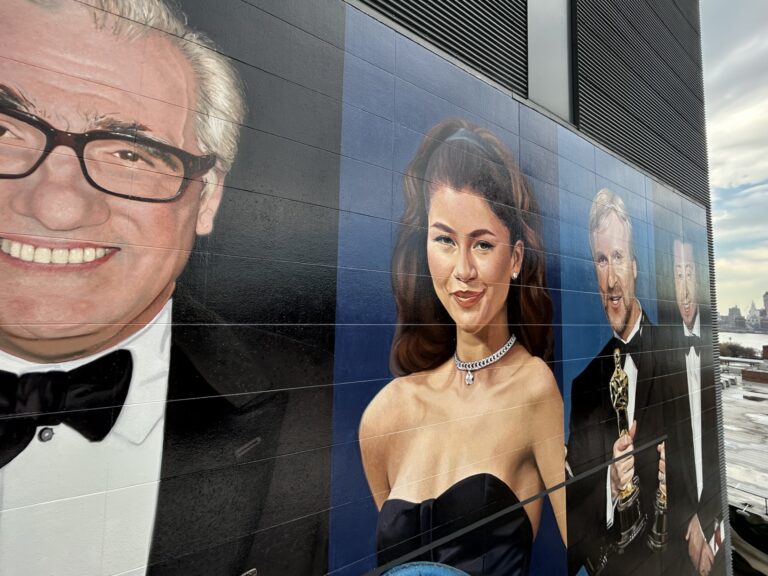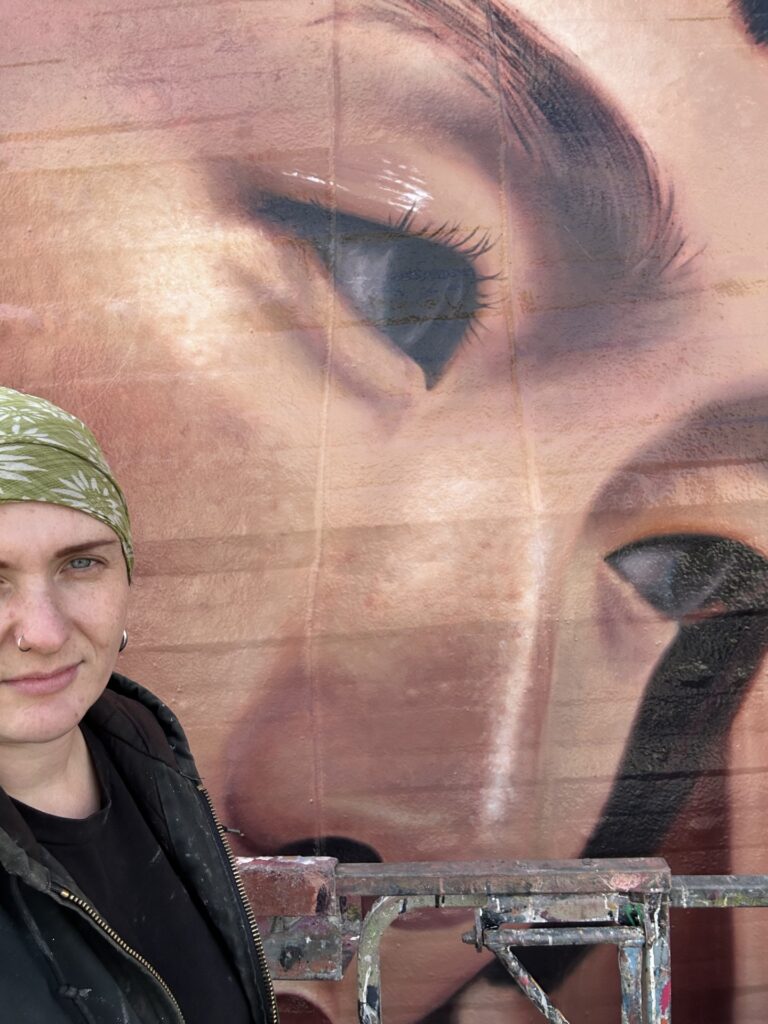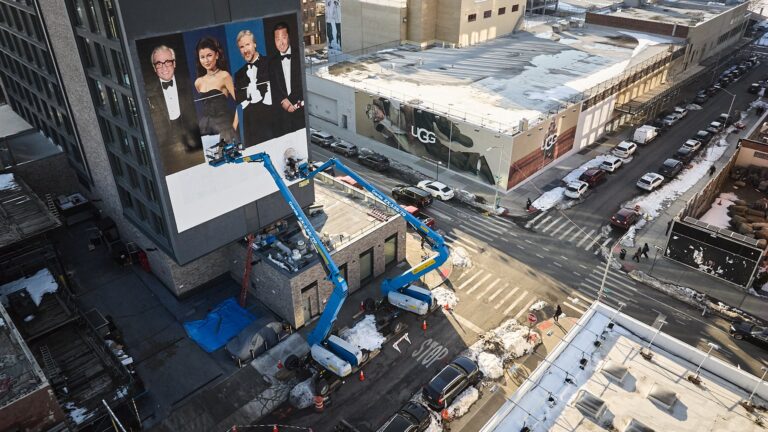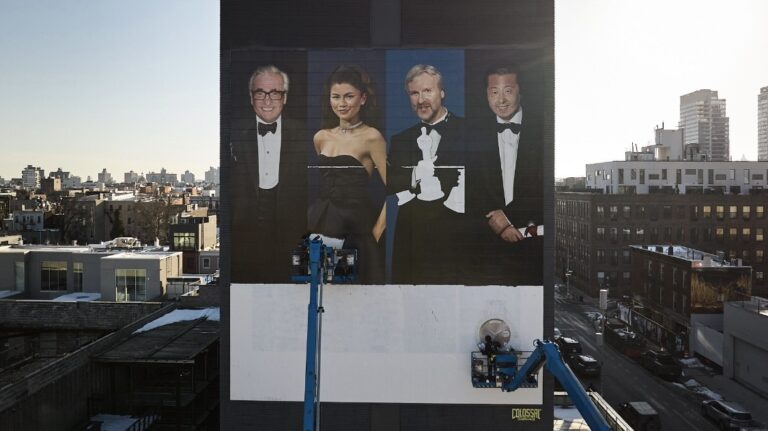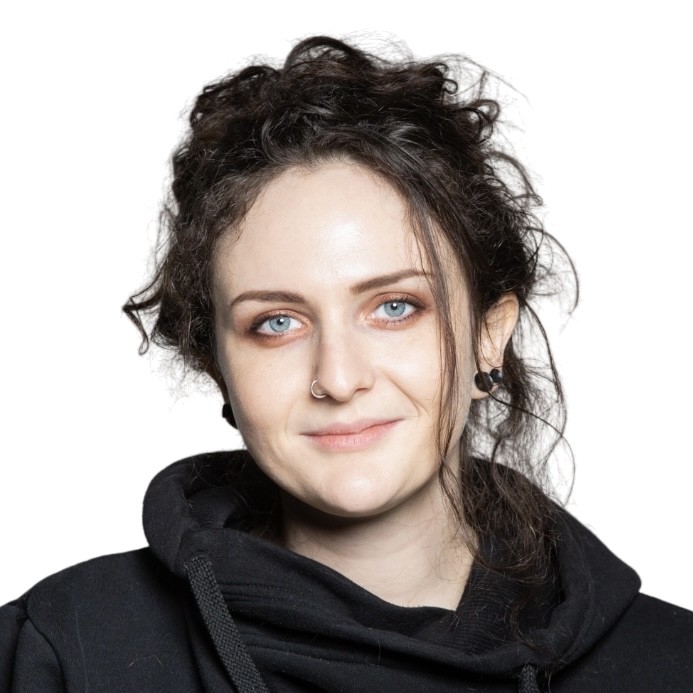
Florida State University alumna Sara Caruso has built a remarkable career that merges fine art, craftsmanship, and public visual culture in unexpected and inspiring ways. As an artist working at Colossal Media, the Brooklyn-based global leader in hand-painted outdoor advertising and public art, Caruso brings painterly skill into the public realm on an extraordinary scale.
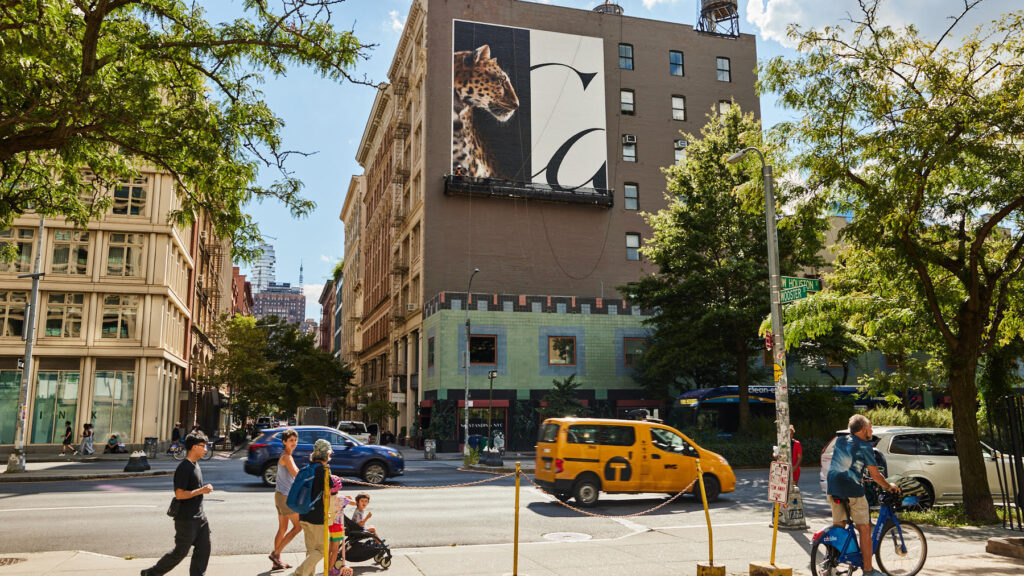
Since joining Colossal Media in 2021, Caruso has contributed to the company’s celebrated mission to “always hand paint,” creating photorealistic large-scale murals and advertisements entirely by hand using traditional painting techniques. Her work transforms city architecture into sites of visual storytelling, where fine art technique, precision, and public engagement intersect. In an era dominated by digital production, her career stands as a compelling testament to the enduring relevance of material skill, craftsmanship, and painting as a living practice.
Working at the intersection of commercial art, public art, and traditional technique, Caruso represents a unique and exciting professional pathway for contemporary artists. Her career demonstrates how rigorous studio training can translate into highly specialized creative industries while maintaining a deep connection to painting’s physical and historical traditions.
In this alumni conversation, Caruso reflects on her journey from Florida State University to painting monumental works on building exteriors, the realities of working at scale, and what it means to sustain a career rooted in handcraft in the contemporary visual landscape.
Insta @ssaracaruso
1. Looking back at your time at Florida State University, what experiences, courses, or faculty mentors most shaped your development as a painter?
I never attempted working with oil paint before college, so I was pretty much a blank slate. Noah Verrier was an adjunct professor at the time – I took his Painting 1 and Landscape Painting courses which built my initial oil painting foundation. Noah got me really into the Impressionists – I started researching their paint palettes and trying to paint as loose as I could. I took Mark Messersmith’s Figure Painting class, and he taught me about form and color theory. I owe a ton to Carrie Ann Baade. She was my mentor professor during my BFA – I took as many of her courses as I could and was even her studio assistant for a bit. I was in Advanced Painting and a couple of her figure drawing courses. Her “Materials and Techniques” course really stuck with me since we went super in depth into old masters’ techniques that just aren’t taught in the modern art curriculum. We did two reproductions to scale, I remember I did a Botticelli egg tempera and a Holbein piece. I took her “Realism” course that was straight up like classical atelier – I really struggled with it since at that point I was a pretty loose painter, which is funny now that I paint so much photorealism. Looking back now I’m really grateful for the technical foundation FSU gave me. A lot of my colleagues that went to art school mention that no one ever really taught them the basics on how to paint representationally.
2. Your current work at Colossal Media involves creating massive hand-painted photorealistic images in public space. How did you first find your way into this highly specialized field? Additionally, can you tell us a little about a typical day painting highly representational oil paintings on the side of a high-rise?
I was living in New York for about a year working as the floral manager at a Whole Foods trying to find any sort of art related job. Unfortunately COVID hit, so any hopes of getting an art handling job or gallery work went out the window. I remember I saw a job post for Colossal Media on craigslist in the summer of 2020 and responded not thinking they would ever get back to me or if it even was a real gig. They got back to me in the late fall and I went through their hiring process and trial days. I knew immediately this job would be a good fit, it was both physical and needed technical painting skills. I started officially in February of 2021.
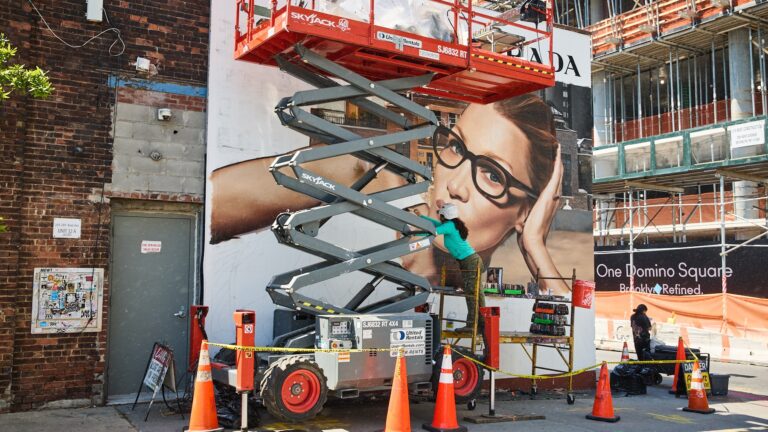
A typical day painting on the side of a highrise starts at our workshop in Brooklyn. We work on suspended scaffolding (which we call a “rig”), boom lifts, and scissor lifts depending on the height of the wall. When working really high up, we typically work on suspended scaffolding and build it all in house. First thing we do is grab all the gear we need (scaffolding material, motors, ladders, paint, etc) and load it up into one of our work trucks. Working at Colossal is half construction half painting – we have to get R1 suspended scaffold supervisor certifications from the city in order to lead these types of jobs. Once the gear is loaded up, a crew of about five painters drive out to our job site and assemble our rig on site. Depending on how complex the build is, this process alone can take an 8 hr day. Once the rig is built and in the air, we prime the wall with white paint and cover the old ad. After that, we’ll start “pouncing” which is when we put up the pattern for the artwork. We prep the patterns in our workshop beforehand with an electro pounce machine. Once the pattern is up, we can finally start thinking about the painting process. An ideal day is when everything has already been set up – you just hop on the rig or lift, unwrap the paint (we usually wrap everything in a tarp for weatherproofing), get your personal workstation set up, and start painting. We have physical artworks that we paint from to keep track of where we are on a huge wall.
3. In a visual culture increasingly dominated by digital production, what draws you to hand-painted work and material craft at this scale?
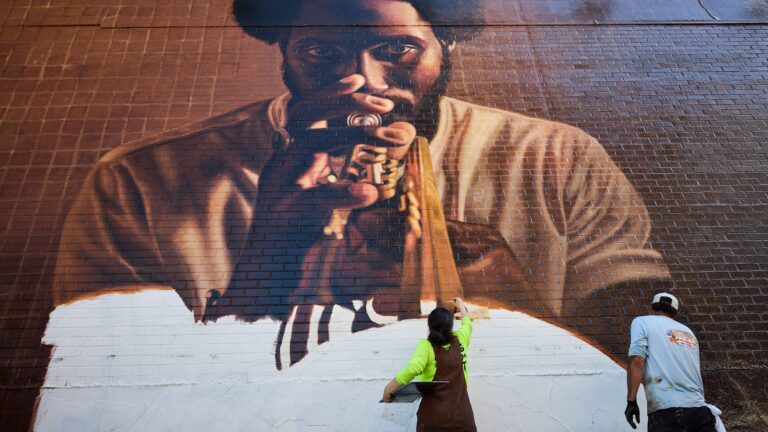
Honestly, it’s the fact that it’s not a giant digital print. When people walk down the street, they assume every massive ad is just a vinyl billboard. But when they notice the brushstrokes, the texture of the brick, or see a human being hanging from a rig actually making it happen, it stops them in their tracks. There’s a vibrancy to hand-painted work that a computer just can’t replicate. I love the fact that we’re keeping a classic, blue-collar trade alive in a world that’s constantly staring at screens.
4. Painting on the side of buildings requires a very different relationship to scale, environment, and audience than traditional studio practice. How has this transformed the way you think about painting?
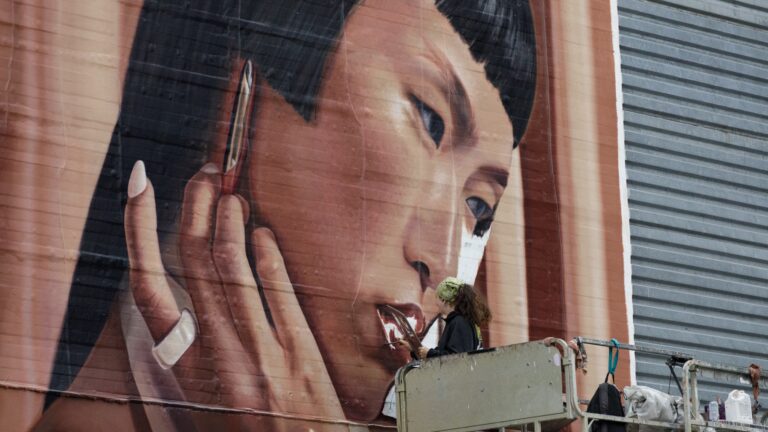
It completely rewires your brain. In a studio, you can take a step back to see if your proportions are right. On a rig, you’re six inches away from the wall painting a giant eyeball that’s six feet wide. You have to blindly trust your grid and your paint because you won’t actually see how it looks until you hop off the rig at the end of the day.
Dealing with elements is another major part of the job. We work all seasons, in the most extreme temperatures. Trying to paint when your fingers are on fire from the cold isn’t for everyone. We often pick and choose what/when to paint something depending on how much sun the wall gets at a certain time of the day. Rain is an obvious disruption, but depending if it’s a little misty or on and off showers can really throw off a work day. Wind is also a big danger for us, between boom lifts swaying in the wind or paint materials flying off the jobsite. You need to be aware of all your surroundings constantly. Depending on how hot or cold it is the paint will react differently, so you have to constantly be changing linseed oil ratios for different seasons.
One of the hardest shifts from being a studio painter to painting above Canal St, was having an audience witness every stage of the painting. I used to be mortified if I did a bad job and would want to fix it right away before my coworkers could judge me. Having a tight deadline changed that real fast. I learned to just slap paint up on the first go, keep moving, fix it later. Studio painter me would noodle on stuff forever and not show anyone until I approved of it.
5. Colossal Media’s philosophy emphasizes craftsmanship, storytelling, and public engagement. How do you see your own artistic sensibilities intersecting with that mission?
FSU really instilled a respect for craftsmanship in me – the idea that the way you make something matters. Colossal’s “Always Hand Paint” motto fits right into that. Even though we’re painting commercial ads, we’re doing it through a historic craft that respects the neighborhood and turns a boring commute into something interesting for the people walking by. It proves that commercial work can still hold onto artistic integrity.
6. What technical or conceptual skills from your FSU training have proven most valuable in your current work?
Having a strong background in color theory was huge. We mix all our paint in house and determine the quantities of paint for each artwork. Knowing how to use complimentary colors saved me so much time. Also just being comfortable with different pigments, temperatures, opacity, etc. Some of the painters at Colossal didn’t come from a fine art background – many came from the graffiti world or construction and they had to learn everything on the job, so I felt very lucky to have that up my sleeve.
7. What were the biggest challenges in transitioning from student artist to professional creative practice, and what helped you navigate that transition?
When I was in school my sole focus was creating a huge body of work. I was constantly posting my work on social media trying to get a big following to make it solely as a studio artist when I graduated. I was really prolific at the time and I had a pretty big ego. After graduating I got a studio space in Miami FL and was applying to group shows here and there but I never felt like I was a serious enough artist. I was a technically good painter, but was pretty stumped in my creative process. I dreaded networking at openings and talking about my work in general. I was still painting a bunch, but it almost felt like I was cosplaying being a studio artist. Around COVID I slowed down on my personal paintings, and felt extremely guilty about it. Once I started working at Colossal it all clicked for me. I really had a problem with my self worth being tied to my art practice. I truly loved the technical side of painting and geeking out on color theory. I didn’t care if I was painting something that I came up with, I loved the challenge of making a perfect reproduction – and that’s okay. I’ll get back to making my own personal work eventually, but right now I’m very content where I’m at. I hope this helps anyone else fighting a slump, really find out what you enjoy about the art making process and think about possible career paths there.
8. What advice would you give current FSU art students who may not yet realize the many unconventional career paths available to painters?
Don’t think that a gallery or a teaching job are your only options, that’s where I got stuck for years. The world needs people who know how to mix paint, scale images, and think visually in a ton of different industries. Keep your eyes open to weird paths – whether that’s scenic painting for movies, community murals, or commercial sign painting. Take your foundation classes seriously, learn how your materials work inside and out, and don’t be afraid of hard, physical labor. Your degree can take you a lot higher than you think – literally.