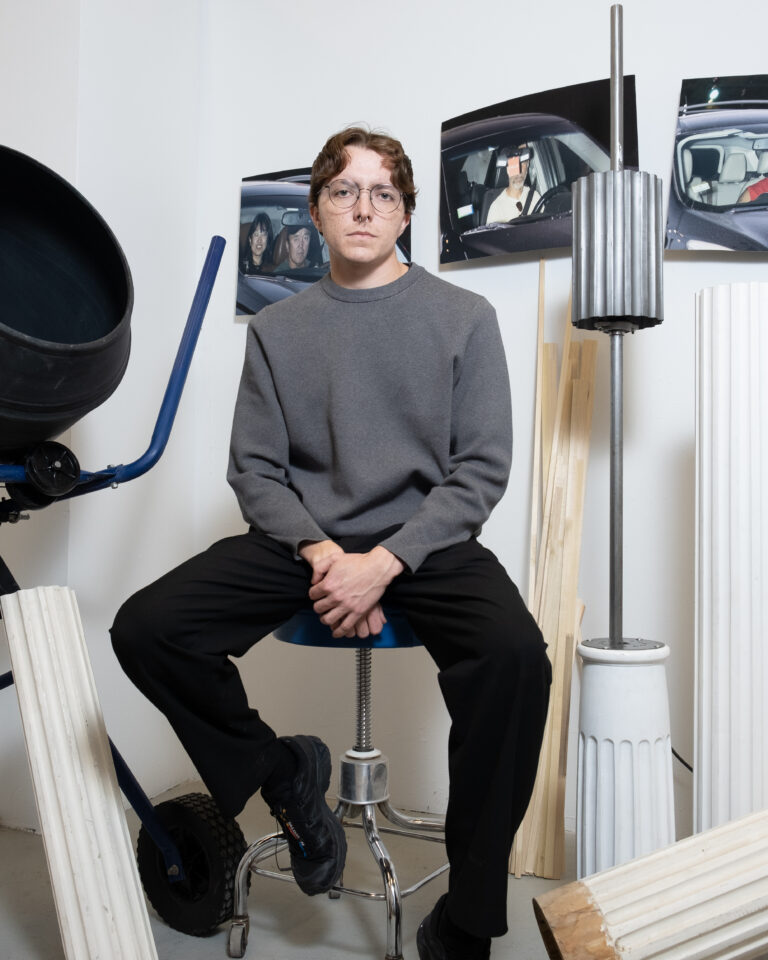
Sculpture and Installation Exploring Masculinity
Florida State University alumnus Zachary Dobbins (BFA Studio Art, Sculpture, 2021) has quickly emerged as a compelling voice in contemporary sculpture and installation, building a practice that is intellectually rigorous, materially inventive, and deeply attuned to the tensions between personal memory and American cultural identity.
After graduating from Florida State University, Dobbins earned his MFA in Sculpture from the School of the Art Institute of Chicago in 2024, one of the nation’s leading programs for experimental contemporary practice. His work spans sculpture, installation, photography, altered objects, and engineered mechanisms, creating immersive environments that examine masculinity, memory, Americana, political anxiety, and the contradictions embedded within contemporary life.
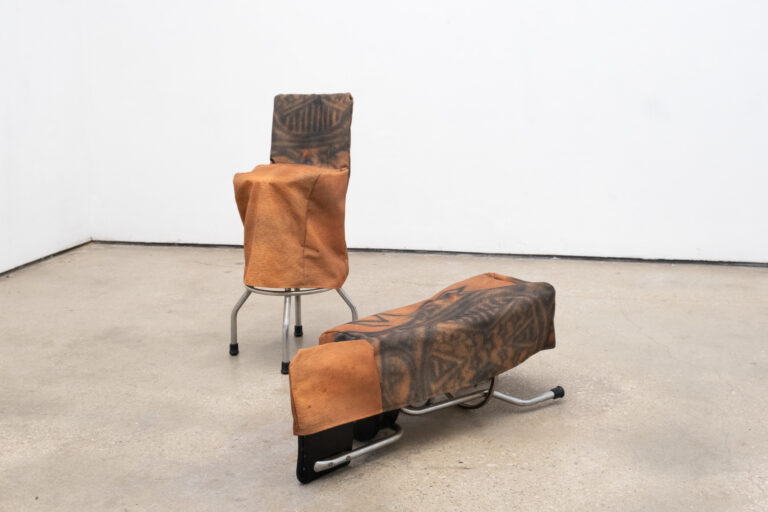
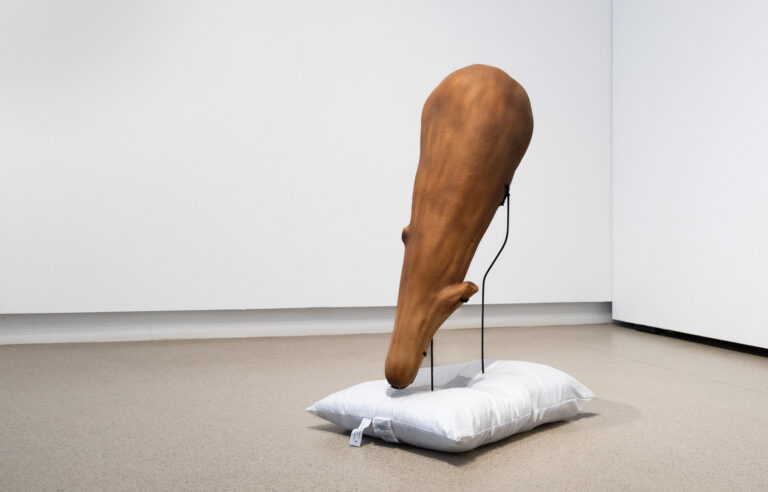
At the center of his recent work is a nuanced exploration of inherited identity, often drawing from the life of his father, a mechanic and hot-rod builder, as both subject and allegorical framework. Through transformed shop objects, photographic surfaces, programmed timing, and cultural references that range from popular media to systems of play and control, Dobbins creates installations that feel simultaneously intimate and socially charged. His work reflects a sophisticated engagement with how personal mythology intersects with broader political and cultural narratives.
His rapidly growing career includes solo exhibitions, artist residencies, curatorial projects, and national exhibitions. Highlights include his solo exhibition AIM AT BASE OF FIRE in La Jolla, California; residencies at Bread & Salt Gallery in San Diego and Poor Farm in Wisconsin; participation in recent exhibitions including Archive as Action, Archive as Discourse in Chicago; and curatorial work exploring themes of identity and Americana.
Dobbins’ career reflects the kind of ambitious contemporary practice that moves fluidly between making, research, installation, and critical inquiry. His path demonstrates how a foundation in sculpture can evolve into conceptually rich interdisciplinary work that speaks directly to the complexity of contemporary culture.
In this alumni conversation, Dobbins reflects on his evolution from FSU sculpture student to emerging contemporary artist, the role of personal history in his work, and what it means to build a practice rooted in observation, experimentation, and critical reflection.
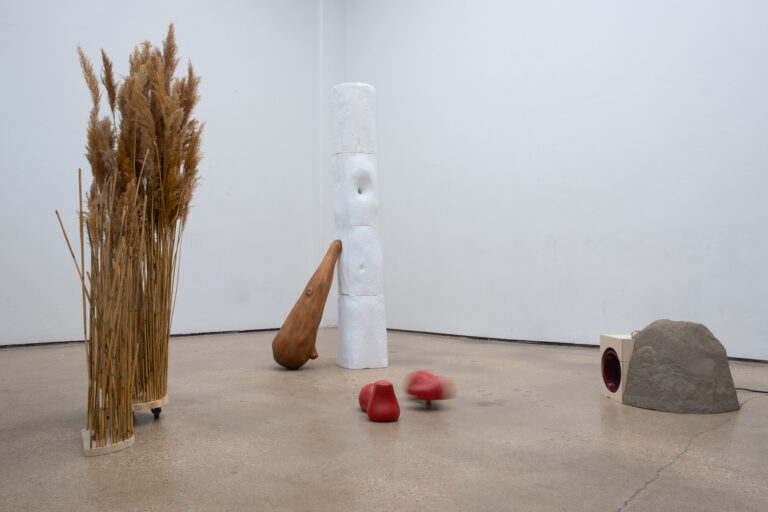
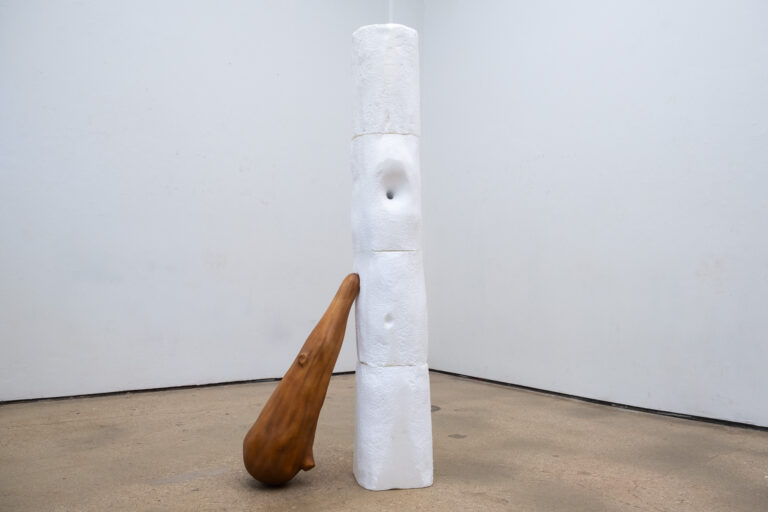
1. Looking back at your time at Florida State University, what experiences, faculty mentors, or projects most shaped your development as an artist?
During my time at FSU, some of the most influential faculty for me were Tom Hall and Rob Duarte. They both held to the idea that if you wanted to make something, you should make it and explore it, with the how and the why could come at any time. With Rob Duarte especially, given his ability to explore the technical side of work, if you wanted to make something electronic or controlled, you could. It wasn’t dependent on the skills you already had; the attitude was, “Now we can teach you how to get there,” or “We can show you how to make whatever it is you’re thinking about.”
The program’s emphasis on the final exhibition and the freedom to explore different mediums was probably the biggest thing for me. As an undergrad—and looking now at undergrads from other institutions—having the ability to explore and expand my conceptual approach, as well as my understanding of what it means to make work and to do the action of art, feels really important. Being able to explore that in an unrestricted way is something FSU’s program allowed me to do successfully. It let me explore modes of making and modes of conceptual engagement. FSU’s open trajectory allowed me to find myself as an artist, and at the same time find myself as a human participating in the world. Rather than just checking the boxes of what it means to be an artist, it was a discovery of how I found myself as one.
2. Your work transforms deeply personal material—particularly family history and memory—into larger reflections on American identity, fear, and cultural contradiction. When did that conceptual direction begin to emerge?
The conceptual direction of my work has been fairly persistent throughout. I was always interested in the larger themes of fear and safety within Americana. Because of my relationship to political engagement and the absurdity of modern political and social engagements, I’d always been drawn to those themes, but I don’t think I had a personal rationale to keep making that work until I was in grad school. Before grad school I had all the tools to get where I am now, but I felt disconnected from the work I was making.
Anything with direct political implications felt like I was making it from a distance, looking at all the ways political absurdity exists in America. It wasn’t until I looked closer at myself, and in turn at my personal history, that I felt a real connection and an “in” to keep exploring the same things, but through the lens of where my particular engagement with Americana was rooted. That wasn’t possible without a personal connection to these fraught, existing ideas. I didn’t want to speak about something as a universality when I had something so particular. That personal connection may expand into a universal digestion (or indigestion) of something, but it starts with where the artist navigates the world. The artist observes and witnesses, rather than applying a greater meaning that feels almost prescribed to the work instead of personally discovered within it.
3. After FSU, you pursued an MFA at the School of the Art Institute of Chicago. How did graduate school challenge or expand your understanding of sculpture and installation practice?
Graduate school took me into that refining of the work, so that it could then open back up again—because now there was this “in,” this conceptual bandwidth for engaging with my work. Now I feel like I have the tools and the confidence to make work and to trust that there’s a tie back to some of the larger things I’m thinking about or that even if the connection isn’t there in the moment, there will be a time when it ties back in.
Grad school specifically at SAIC, with the caliber of faculty and the rigor of the school, taught me not just how to defend the practice but how to instill a specific confidence in the work, because it’s backed up by theory and by real engagement with the sculpture.
4. Your work combines altered objects, photography, mechanisms, and installation in ways that feel both intimate and psychologically charged. How do you decide what form an idea needs to take?
Because of my engagement with sculpture and the way sculpture interacts with the reality of our world, I think what sculpture does is bring something into the now; it carries a certain gravity that’s missing from some other work. Deciding the form feels like a natural response. Whether something involves engineered mechanisms or is a still piece, there’s a rationale relating to reality despite its potential distance from it.
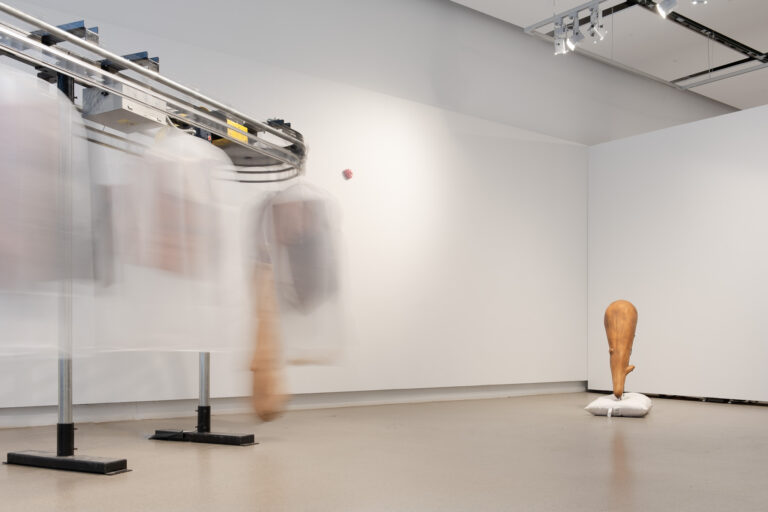
The biggest thing is that I’m continuing to explore where these ideas fit within a specific reality, a specific psychological state, or their interaction with the physical world. Sometimes that exploration happens through mechanized, engineered processes or moving components—another mode of engaging that isn’t just about space as a whole, but about space and time at once, or a navigation of one over the other
5. Your recent projects engage themes of masculinity, nostalgia, political absurdity, and popular culture. How do you navigate balancing humor, critique, and emotional vulnerability in the work?
When it comes to balancing humor, critique, and emotional vulnerability, it often appears and feels like a reflection of reality rather than something I’m imbuing into the work. Critique is the element that could feel most placed or deliberate, but a lot of it feels like a reflection, mirroring the absurdity back in a way that prompts a critical lens. Some of the work isn’t critical the first time you encounter it, but the way it repeats or cycles through the critique comes through the consistency of that reflection, coming back and back and back again. That’s part of why there are cycles and repetition in the work. So it’s balanced in a natural way, because it’s a natural reflection of observation and witnessing.
6. You have developed a strong exhibition and residency trajectory early in your career. What strategies or mindsets helped you build momentum after graduation?
Continuing the momentum of school was really important to me. Having something like a studio, a collaboration space, or anything that keeps you engaged with the work mattered a lot. Finding yourself in a community of artists in any way possible, whether through a job or through residency programs, kept me accountable and kept me engaged with my broader practice.
That led into applying for residencies and submitting proposals. For me, residencies and exhibition proposals were a way to zoom in more directly on those ideas. Putting together a well-formed proposal and sending it to a gallery, exhibition space, or residency did two things: it let me pack those ideas into something concrete, and it gave those spaces an easy decision—everything they needed was right there, so all they had to do was say yes or no. I think that led to the success I had in securing several of these opportunities before grad school.
7. Many students imagine sculpture as a static object-based discipline, but your practice is immersive and interdisciplinary. How has your relationship to sculpture evolved over time?
The way my sculpture has evolved always started with an interest in an interdisciplinary approach, because that’s what drew me in. Looking back, I got into sculpture in a very “boyish” way—looking at works by Chris Burden and Michael Heizer and realizing that this was possible. Not that it was the model, but that there could be these large, absurd mechanisms and performances, work deemed successful enough that someone could make it, keep making it, and sustain a career doing so. That was inspiring.
So for me the door was always open with work that wasn’t static and open to immersive and interdisciplinary practices and I’ve stuck with that. There’s an ebb and flow between the static work I’m interested in and the more immersive installations. As a sculptor concerned with space, I’m always bouncing back and forth between many modes to explore.
8. What advice would you give current FSU art students who want to build a serious contemporary practice grounded in experimentation and critical inquiry?
The advice I’d give to a current student, especially as an undergraduate, is to just keep exploring. Keep making things. You don’t have to work them into the ground, but it’s important to have a practice that explores rather than one that becomes so pointed it’s almost predefined. And make a lot of bad work. The most important thing for a young artist to do is make things, and in doing that you’re going to make plenty you’d consider bad—but that either pushes you to the next thing or becomes something in itself.
For me it comes down to consistency: making something, and giving yourself goals—like submitting proposals to galleries you have no business being in. That’s what has kept me going and kept me engaged in experimental work.